PUSAT KAJIAN SAMUDERA & PANTAI | Universiti Sains Malaysia

AquaSmart – Planning tool for sustainable aquaculture development
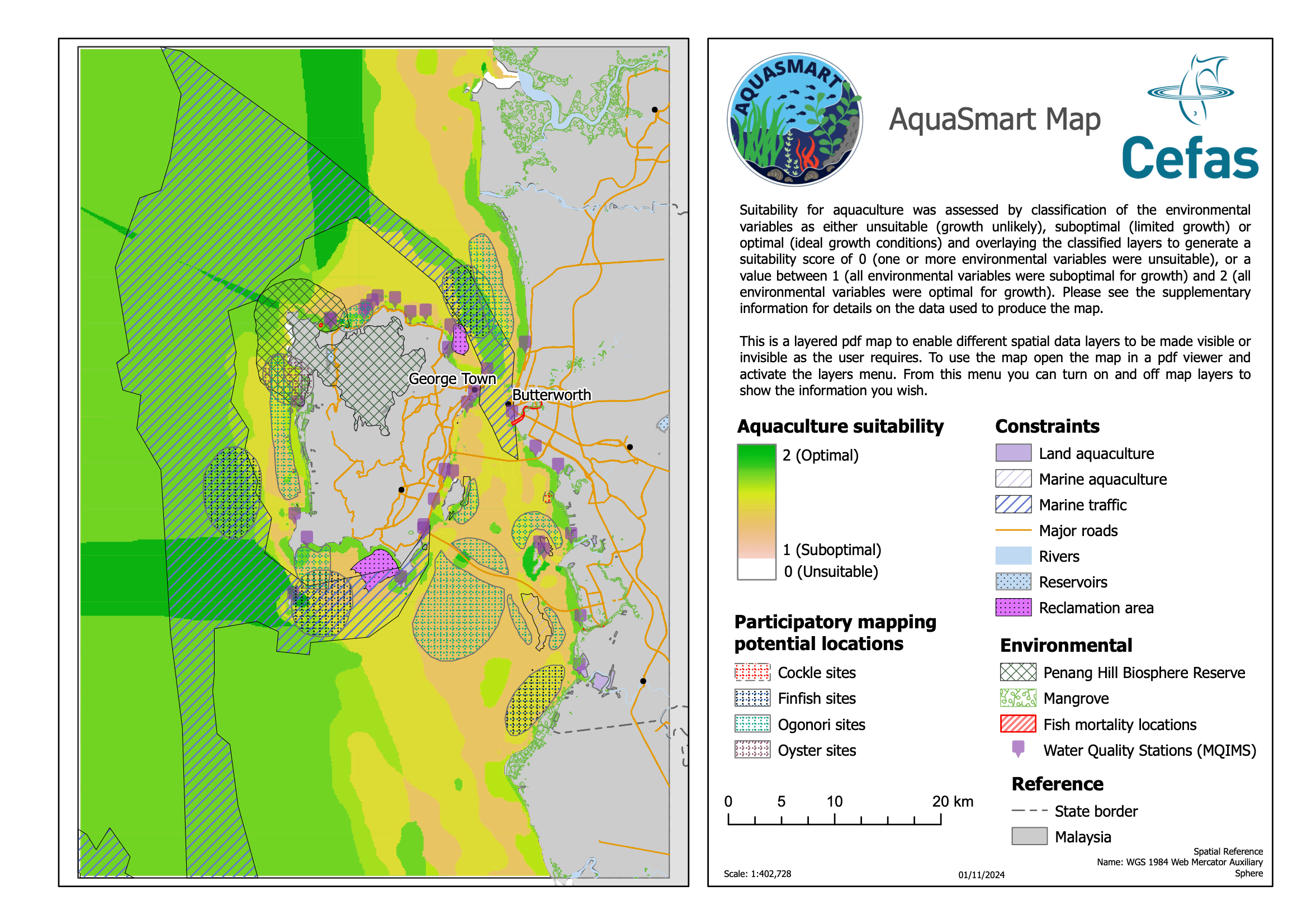
 aquaAquaSmart aims to apply a GIS tool for aquaculture planning to support sustainable aquaculture development in Penang aligning with the Penang 2030 Agenda on food security and environmental health. 


OVERVIEW

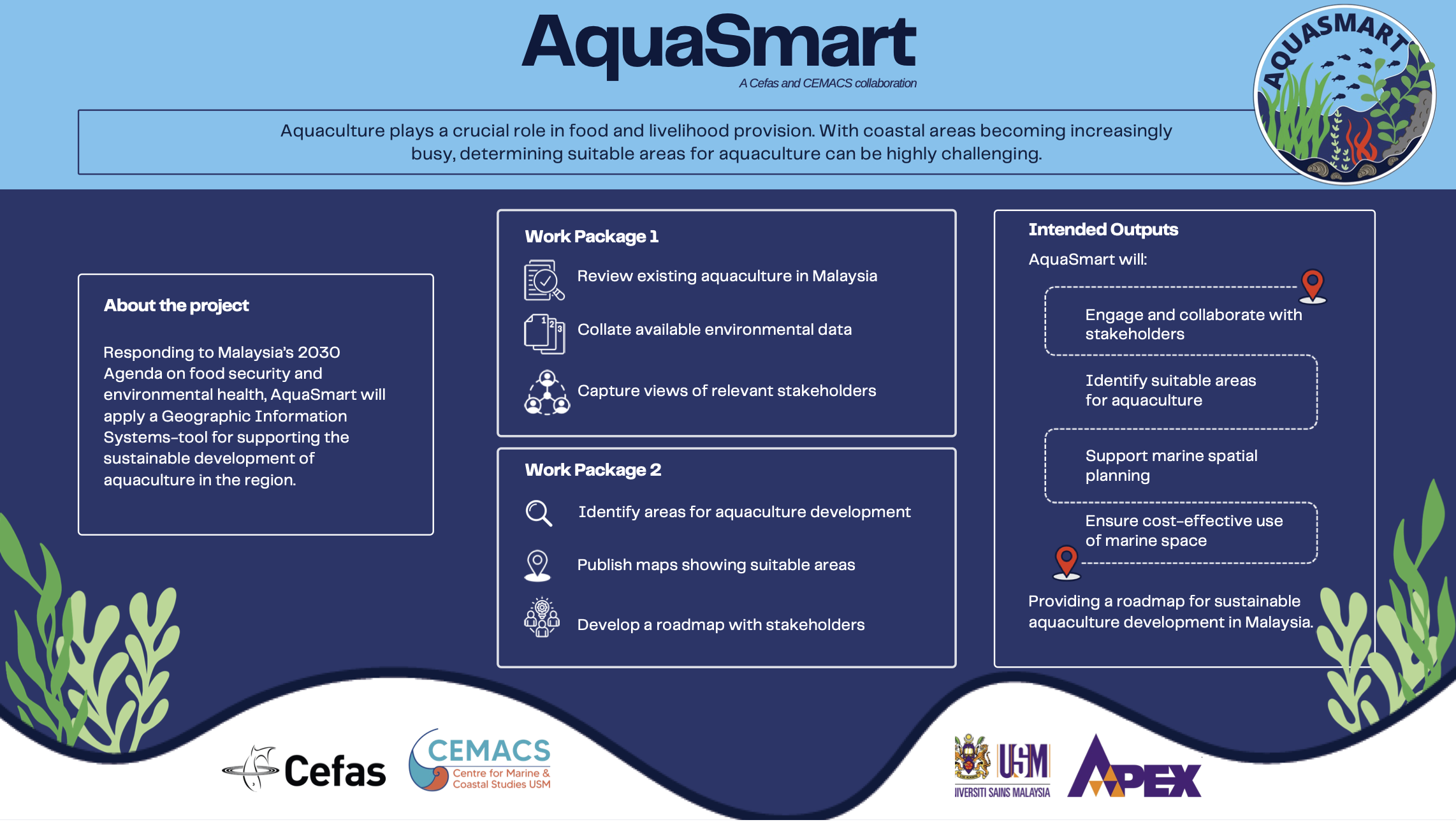
The AquaSmart - Planning Tool for Sustainable Aquaculture Development project has been launched, supported by the Department for Science, Innovation and Technology (DSIT) in collaboration with the Centre for Environment, Fisheries and Aquaculture Science (Cefas) and the Centre for Marine and Coastal Studies (CEMACS) at Universiti Sains Malaysia (USM). This initiative aims to employ Geographic Information Systems (GIS) for effective aquaculture planning in Malaysia, particularly in Penang in the northwest region of the Peninsular Malaysia.

Aquaculture is vital for food supply and livelihoods but faces spatial conflicts due to the diverse uses of coastal areas, such as recreation, navigation, and conservation. The project seeks to address these challenges by finding optimal locations for aquaculture that meet environmental conditions for species growth and minimize conflicts with existing marine activities. This approach not only promotes efficient use of marine space but also supports co-location of aquaculture with other activities, enhancing cost-effectiveness.

The project is structured into two main work packages:

  1. Work Package 1 (WP1) focuses on:
    • Reviewing the current aquaculture species, production systems, and their uses in Malaysia.
    • Collating environmental data for the designated study areas.
    • Organizing a scoping workshop with stakeholders from various sectors to discuss aquaculture interests and opportunities.
  2. Work Package 2 (WP2) involves:
    • Identifying suitable areas for low-carbon-footprint and integrated multitrophic aquaculture (IMTA) using a GIS tool based on the environmental data and stakeholder input gathered in WP1.
    • Uploading maps of identified areas to the CEMACS project website.
    • Conducting a final workshop to present the identified areas and outline a sustainable aquaculture development roadmap for the region.

The AquaSmart project aligns with the UK's goal of influencing global standards through emerging technologies and supports Malaysia's 2030 Agenda to leverage such technologies for enhancing food security and environmental health. Through this collaborative effort, this research project aims to establish a framework for sustainable aquaculture development that can be replicated and scaled both nationally and internationally.

Institutions Involved:

  2nd Workshop 4

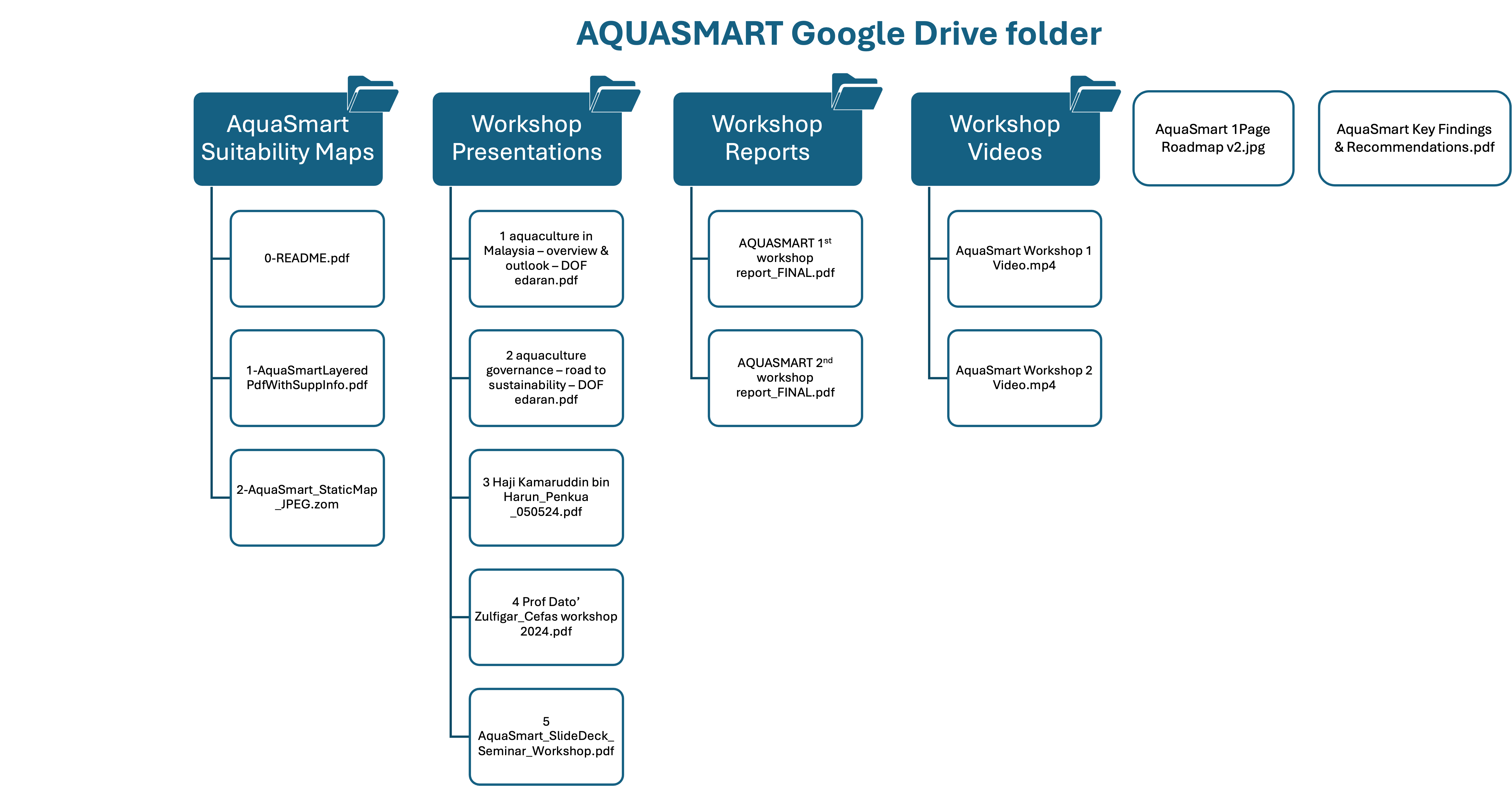
PROJECT DELIVERABLES

  • Stakeholder Workshop Reports
  • Site Suitability Maps
  • Key Findings & Recommendations
  • Roadmap for Sustainable Aquaculture in Penang

Link to Deliverables: https://drive.google.com/drive/folders/15ichJcOgafs991mFsQc4x7u9HTLn6tij?usp=sharing
Citation and link to AquaSmart Aquaculture Suitability Layers:
Heal et al. (2025). AquaSmart Aquaculture Suitability Layers for Penang, Malaysia. Cefas, UK. V1. doi: https://doi.org/10.14466/CefasDataHub.162


Google_Drive_Content.png


AquaSmart_Infographic_v2.png

Aquasmart_map_v2_1.png

Disclaimer: The information provided by the AquaSmart project, including all geographic information system (GIS) outputs and maps, is for informational purposes only. The Centre for Marine and Coastal Studies (CEMACS), Centre for Environment, Fisheries and Aquaculture Science (Cefas), Department for Science, Innovation and Technology (DSIT), and associated partners do not guarantee the accuracy or completeness of this data and shall not be liable for any errors, omissions, or inaccuracies. Users assume all responsibility for verifying the utility and reliability of this information in their decision-making processes. The project partners are not responsible for any losses, damages, or injuries resulting from the use or reliance on this information. This disclaimer applies to all outputs from the project.


Contact person:

Prof. Dato’ Dr. Aileen Tan Shau Hwai – Alamat emel ini dilindungi dari Spambot. Anda perlu hidupkan JavaScript untuk melihatnya.

Norhanis Razalli – Alamat emel ini dilindungi dari Spambot. Anda perlu hidupkan JavaScript untuk melihatnya.


  • Hits: 1218

Community-Based Seagrass Meadows Conservation in Penang South Channel

Sim Yee Kwang1, Wan Mustaffa Wan Din1, Omar Ahmad1, Kumaradevan A/L Saminathan1, Ahmad Rafaiee1, Leela Rajamani1, Anita Talib2 & Khairun Yahya3
1Centre For Marine & Coastal Studies (CEMACS), Universiti Sains Malaysia, 11800 USM Penang, Malaysia.
2School of Distance Education, Universiti Sains Malaysia, 11800 USM Penang, Malaysia.
3School of Biological Sciences, Universiti Sains Malaysia, 11800 USM Penang, Malaysia.
Corresponding author’s e-mail: Alamat emel ini dilindungi dari Spambot. Anda perlu hidupkan JavaScript untuk melihatnya.
 
Abstract of Research (Mac 2012 - Sep 2013)
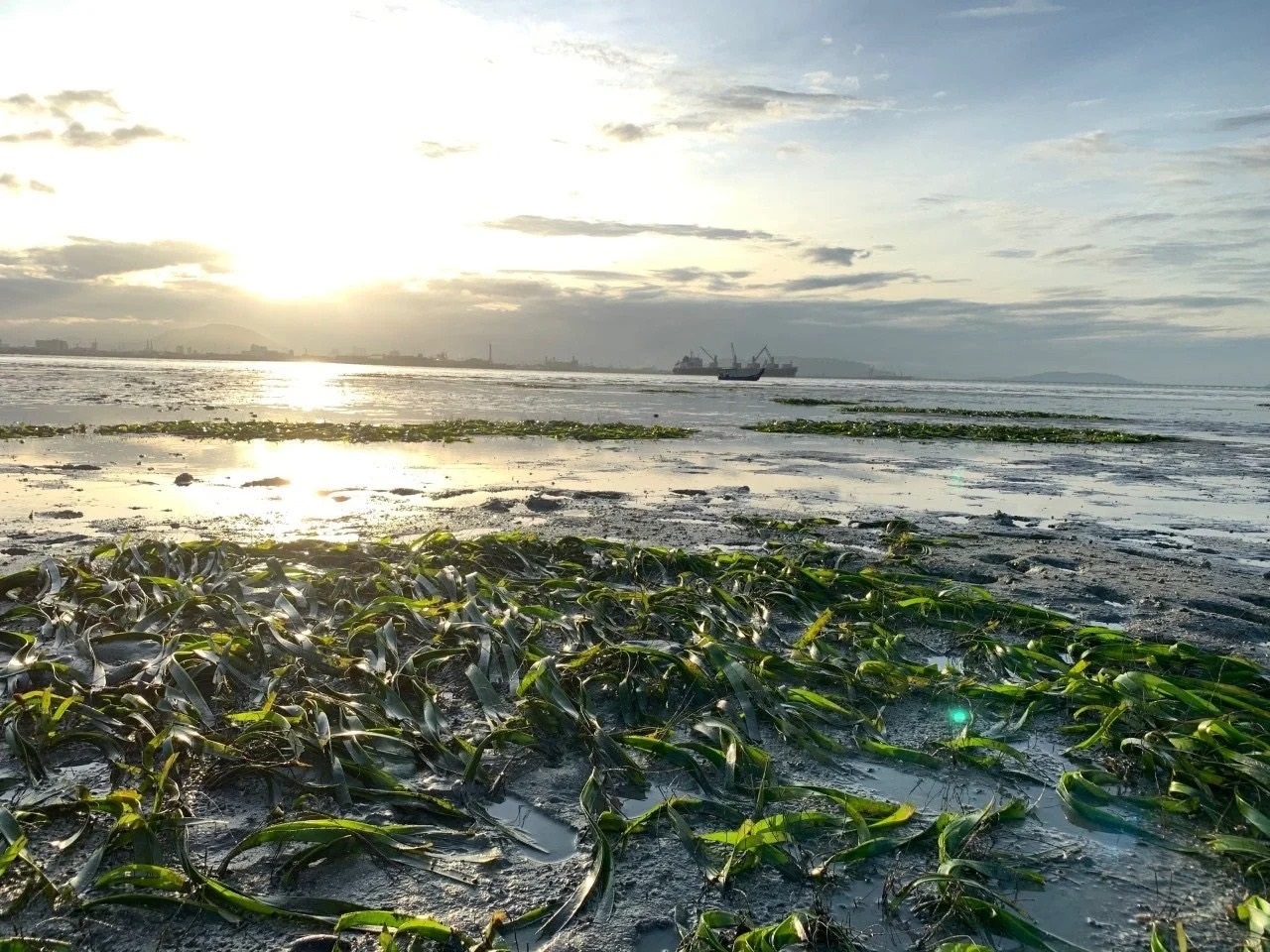
WhatsApp Image 2024 11 05 at 10.18.54 AM
 
The project site was chosen at Penang South Channel (a channel separating Penang Island and mainland Peninsular Malaysia) due to its rich biodiversity and fisheries with a significant number of coastal communities relying on them for their livelihood. As many developments have been planned around South Channel (especially seagrass meadows near Penang bridge), it is extremely crucial to strengthen the community’s sense of ownership in order to safeguard these resources. This sustainable livelihood based project aims to empower the local community and public volunteers in resource assessment and monitoring; furthermore to raise marine awareness in the local schools through education and outreach activities within the project duration of one year. The local community participants, public volunteers and corporate members will be given training and take part in seagrass meadow monitoring & assessments through Seagrass-Watch method/program as seagrass serves as vital fish nursery grounds and the seagrass conditions reflects the overall health of South Channel. Seagrass also able to absorb nutrients from coastal run-off and stabilize sediment, helping to keep the water clear. Results indicated that intertidal area of Pulau Gazumbo is dominated by Halophila ovalis with average percentage coverage observed (43.78%) during the monitoring period. The sediments found at the intertidal area of Pulau Gazumbo were mostly muddy, thus favouring the dispersion of H. ovalis. However, Enhalus acoroides and H. beccarii were found in low abundance. The macrobenthos found in Pulau Gazumbo were dominated by crustaceans (58.79%); followed by gastropod (33.40%) and worm (4.33%). Lowest percentage group was sea cucumber (0.07%). Despite its small size (14.25 km2), Pulau Gazumbo has diversed macrobenthos. A total of selected 32 participants were interviewed to obtain their opinions about the seagrass monitoring programme. More than half (59%, n=19) of the participants gave positive response when asked their general opinions about the seagrass monitoring. Only 19% (n=6) were negative of the monitoring while the rest (22%, n=7) were neutral. Majority (75%, n=24) of the participants felt benefited from the programme in term of knowledge gained (50%, n=16), research skill gained (16%, n=5) and having fun (9%, n=3). The findings of this study suggest that adequate support and training towards local communities are keys to monitor the changes in seagrass ecosystem in response to natural and anthropogenic impacts. Community-based monitoring programmes are important to coastal management especially when government agencies with limited funding and resources to monitor and manage the seagrass resources.
 
Keywords: Community-Based, Seagrass Meadows, Conservation, Penang South Channel
  • Hits: 4803

The Monthly Distribution & Abundance of Jellyfish (Medusae) Species in the Coastal Waters of Penang National Park, Penang, Malaysia.

 
Sim Yee Kwang1 & Khairun Yahya1,2
1Centre For Marine & Coastal Studies (CEMACS), Universiti Sains Malaysia, 11800 USM Penang, Malaysia.
2School of Biological Sciences, Universiti Sains Malaysia, 11800 USM Penang, Malaysia.
Corresponding author’s e-mail: Alamat emel ini dilindungi dari Spambot. Anda perlu hidupkan JavaScript untuk melihatnya.

 Summary of Research

A study of monthly abundance and distribution of jellyfish population was conducted for 18-months period around the coastal waters of Penang National Park (PNP), Penang, Malaysia started November 2009 until April 2011. Towing and scooping methods were applied for samples collection using fishing boat cruising at the speed of approximately 2.5 nautical knots during neap tide. The scooping method used visual observation to detect jellyfish from the water surface.  Meanwhile towing method required a custom-made trawl towed behind the boat for submerged jellyfish specimen. A total number of five jellyfish species from five different genera were identified, namely; Phyllorhiza punctata, Chrysaora sp., Rhopilema sp., Chiropsoides buitendijki, and Carybdea morbakka. The dominant Chrysaora sp.contributed up to 96.58% of the total jellyfish catch.  The maximum jellyfish number recorded was 57.07±12.37 individuals/1000m3 in May 2010. No occurrences of significant jellyfish bloom but their presence were observed throughout the whole sampling periods.

Baca selanjutnya: The Monthly Distribution & Abundance of Jellyfish (Medusae) Species in the Coastal Waters of...

  • Hits: 10448

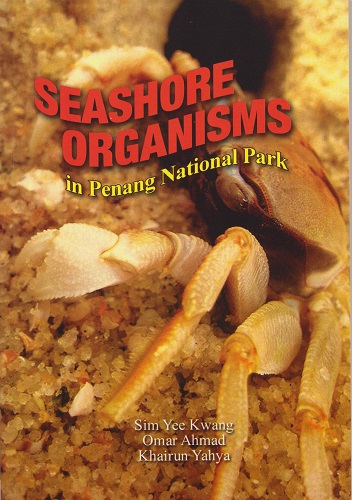
Field Guide to the Seashore Organisms in Penang National Park

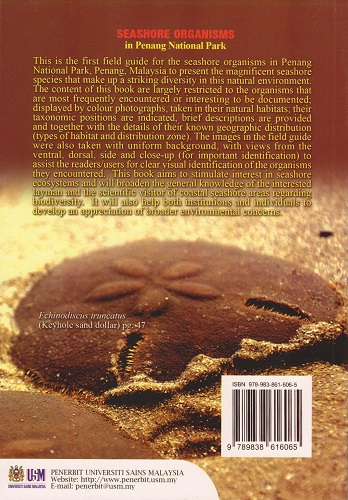
PNP_Seashore_Field_Guide_01.jpgPNP_Seashore_Field_Guide_02.jpg

Synopsis

This is the first field guide for the seashore organisms in Penang National Park, Penang, Malaysia to present the magnificent seashore species that make up a striking diversity in this natural environment. The content of this book are largely restricted to the organisms that are most frequently encountered or interesting to be documented; displayed by colour photographs, taken in their natural habitats; their taxonomic positions are indicated, brief descriptions are provided and together with the details of their known geographic distribution (types of habitat and distribution zone).

Baca selanjutnya: Field Guide to the Seashore Organisms in Penang National Park

  • Hits: 6332